Steam Machine benchmarks reveal Windows performance edge at 4K
technology
informative
controversial

Steam Machine benchmarks reveal Windows performance edge at 4K

10
(Update: )
American video game development and digital distribution company
company
2017 action role-playing video game
Linux-based operating system
  • ETA PRIME conducted benchmarking tests on the Steam Machine using Windows drivers released by Valve.
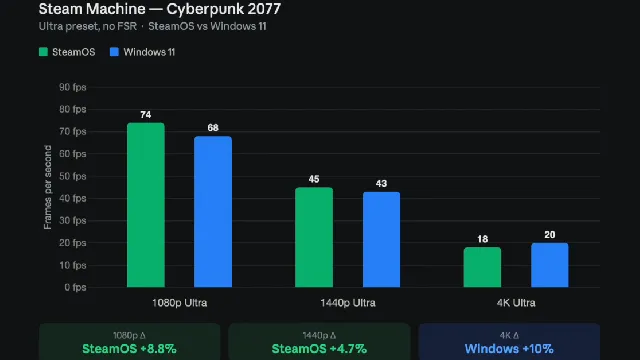
  • SteamOS outperformed Windows in 1080p resolution across three tested games.
  • Windows showed a slight performance advantage at 4K resolution, suggesting different OS benefits based on gaming resolution.
Share opinion
1

Story

In recent months, ETA PRIME has been revisiting the performance of the Steam Machine, particularly when it is running Windows. This evaluation was prompted by the release of new Windows drivers from Valve, which aimed to enhance the gaming experience on the Steam Machine. The benchmarking tests were conducted on a unit equipped with 64GB of RAM, allowing for a comprehensive assessment of its capabilities across various gaming titles. The three games selected for testing were Cyberpunk 2077, Shadow of the Tomb Raider, and Horizon Zero Dawn, which are known for their demanding graphics and performance requirements. The results of the benchmarking revealed that SteamOS outperformed Windows in 1080p resolution across all three games tested. This finding suggests that for gamers who primarily play at 1080p, SteamOS may provide a better experience in terms of frame rates and overall performance. However, the situation changed at 4K resolution, where Windows managed to achieve a slight advantage, moving ahead by a couple of frames per second. This indicates that while SteamOS may be optimized for lower resolutions, Windows could be the better choice for those looking to game at higher resolutions. The implications of these findings are significant for gamers considering which operating system to use on their Steam Machine. The choice between SteamOS and Windows may depend on the resolution at which they plan to play their games. For those who prioritize 1080p gaming, SteamOS appears to be the superior option, while Windows may be more appealing for gamers who want to experience titles at 4K resolution. This benchmarking exercise highlights the ongoing debate within the gaming community regarding the best platform for optimal performance. As the gaming landscape continues to evolve, the performance of gaming systems like the Steam Machine will remain a topic of interest. With advancements in hardware and software, gamers will need to stay informed about which operating systems and configurations provide the best experiences for their gaming preferences. The results from ETA PRIME's tests serve as a valuable resource for those looking to make informed decisions about their gaming setups.

Context

The performance comparison between SteamOS and Windows for Steam Machines is a critical area of study for gamers and developers alike. SteamOS, developed by Valve Corporation, is a Linux-based operating system designed specifically for gaming, while Windows is a widely used operating system that supports a vast array of applications, including games. The performance of these two operating systems can significantly impact the gaming experience, influencing frame rates, load times, and overall system responsiveness. This report aims to provide a concise analysis of the performance differences between SteamOS and Windows, focusing on key metrics that matter to gamers. In terms of gaming performance, Windows has historically had the upper hand due to its extensive support for a wide range of hardware and software. Most game developers optimize their titles for Windows, resulting in better performance and compatibility. Benchmarks often show that games run smoother on Windows, with higher frame rates and lower latency. SteamOS, while improving over the years, still faces challenges in terms of driver support and game optimization. Many popular titles are either not available on SteamOS or do not perform as well as they do on Windows, which can be a significant drawback for gamers looking for the best experience. However, SteamOS offers unique advantages, particularly for users who prioritize open-source software and a console-like experience. The operating system is designed to be user-friendly and integrates seamlessly with the Steam platform, allowing for easy access to a vast library of games. Additionally, SteamOS is optimized for performance on lower-end hardware, making it an attractive option for budget-conscious gamers. The ability to customize the system and the potential for better performance in specific titles that are optimized for Linux can also be appealing. Furthermore, the growing support for Proton, a compatibility layer that allows Windows games to run on Linux, has improved the gaming experience on SteamOS, bridging some of the gaps in performance. Ultimately, the choice between SteamOS and Windows for gaming on Steam Machines depends on individual preferences and priorities. Gamers who seek the best performance and compatibility with the latest titles may lean towards Windows, while those who value an open-source environment and a streamlined gaming experience may prefer SteamOS. As the gaming landscape continues to evolve, both operating systems are likely to see improvements, and ongoing developments in software and hardware will further influence their performance. In conclusion, while Windows currently holds a performance advantage, SteamOS is making strides that could make it a viable alternative for a segment of the gaming community.