Iran threatens global trade by challenging freedom of navigation
politics
impactful
controversial

Iran threatens global trade by challenging freedom of navigation

31
(Update: )
country in Western Asia
seawater inlet of the Indian Ocean
  • US Secretary of State Marco Rubio addressed ASEAN ministers about Iran's control over the Strait of Hormuz.
  • He warned that Iran's actions threaten global trade and could set a dangerous precedent for maritime routes.
  • Rubio emphasized the importance of freedom of navigation and the US's commitment to protecting its interests.
Share opinion
3

Story

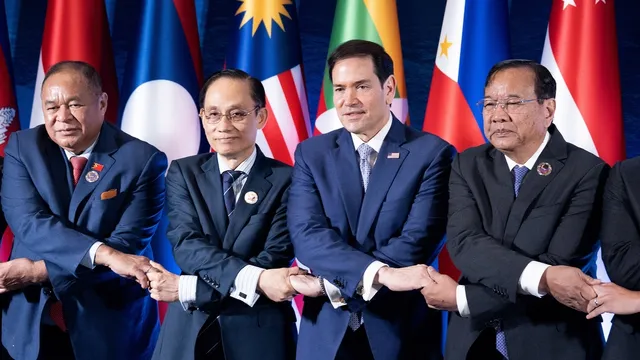
On July 22, 2026, in Manila, Philippines, US Secretary of State Marco Rubio addressed ministers from the Association of Southeast Asian Nations (ASEAN) regarding the escalating tensions surrounding the Strait of Hormuz. He highlighted Iran's increasing control over this vital maritime passage, which is crucial for global trade, particularly in energy supplies. Rubio emphasized that Iran's actions not only jeopardize the freedom of navigation in the Strait of Hormuz but also set a dangerous precedent for other contested maritime routes in Asia. He expressed the United States' commitment to diplomacy but criticized Iran for not being serious about negotiations. Rubio's remarks came amid heightened military exchanges and US strikes targeting Iranian military infrastructure linked to threats against commercial shipping. He warned that allowing Iran to dictate shipping through the Strait of Hormuz would undermine fundamental principles of international commerce. The Strait of Hormuz is a critical chokepoint through which approximately 20% of the world's energy supply passes, making the situation particularly urgent for global economic stability. The Secretary of State argued that if Iran were allowed to control this international waterway, it could lead to similar behavior in other regions, potentially destabilizing maritime trade routes worldwide. He pointed out that the implications of the Strait of Hormuz dispute extend beyond the Middle East, affecting the global economy and the rules that have governed international trade for over a century. Rubio's message was clear: the US will take necessary actions to protect its interests and those of its allies if Iran continues its aggressive stance. In addition to addressing the immediate threats posed by Iran, Rubio reassured Southeast Asian nations of the US's commitment to the region. He described ASEAN as a primary mechanism for US regional engagement and announced plans for significant investments in various sectors, including energy security and infrastructure. This commitment aims to strengthen partnerships and ensure that US relations with major powers do not come at the expense of its alliances in Southeast Asia. The ongoing situation in the Strait of Hormuz remains a focal point for US foreign policy, with potential ramifications for international trade and security.

Context

The Strait of Hormuz is a strategically vital waterway that connects the Persian Gulf to the Gulf of Oman and the Arabian Sea. It is one of the most important maritime chokepoints in the world, through which approximately 20% of the global oil supply passes. This narrow strait, only about 21 miles wide at its narrowest point, serves as a critical transit route for oil tankers and liquefied natural gas (LNG) carriers. The geopolitical significance of the Strait of Hormuz is underscored by the fact that it is bordered by several key nations, including Iran, Oman, and the United Arab Emirates, each of which has a vested interest in the security and accessibility of this passage. Any disruption in this area can have immediate and far-reaching implications for global trade and energy markets. The impact of the Strait of Hormuz on global trade is profound, particularly in the context of energy supplies. A significant portion of the world's oil exports, including those from major producers like Saudi Arabia, Iraq, and the United Arab Emirates, must transit through this strait. Consequently, any geopolitical tensions, military conflicts, or threats to shipping security in the region can lead to increased shipping costs, insurance premiums, and volatility in oil prices. For instance, historical events such as the Iran-Iraq War and more recent tensions involving Iran have led to fears of potential blockades or attacks on tankers, prompting global markets to react swiftly to any signs of instability. Moreover, the Strait of Hormuz is not only crucial for oil but also for natural gas exports. Countries like Qatar, which is one of the largest LNG exporters in the world, rely on this route to deliver their products to international markets. The potential for disruptions in the strait can lead to supply shortages and increased prices for natural gas, affecting energy consumers and industries worldwide. As nations seek to diversify their energy sources and reduce dependence on oil, the importance of the Strait of Hormuz remains significant, as it continues to be a key transit point for energy resources that fuel the global economy. In conclusion, the Strait of Hormuz plays an indispensable role in global trade, particularly in the energy sector. Its strategic location and the volume of trade that passes through it make it a focal point for international relations and economic stability. The potential for conflict or disruption in this region poses risks not only to the countries directly involved but also to the broader global economy. As such, maintaining security and open navigation in the Strait of Hormuz is essential for ensuring the uninterrupted flow of trade and energy supplies, which are critical for the functioning of modern economies.